OGEA-103 Detail Explanation | Valid OGEA-103 Test Forum
Wiki Article
2026 Latest PassSureExam OGEA-103 copyright and OGEA-103 copyright Free Share: https://drive.google.com/open?id=1p8zPDwFnvdW_Xg4PDG56Sn-S9Px5qKui
All customer information to purchase our OGEA-103 guide torrent is confidential to outsides. You needn't worry about your privacy information leaked by our company. People who can contact with your name, e-mail, telephone number are all members of the internal corporate. The privacy information provided by you only can be used in online support services and providing professional staff remote assistance. Our experts check update on the OGEA-103 Exam Questions every day and keep customers informed. If you have any question about our OGEA-103 test guide, you can email or contact us online.
The Open Group OGEA-103 certification exam is recognized globally as a standard for measuring the competency of enterprise architects. TOGAF Enterprise Architecture Combined Part 1 and Part 2 Exam certification demonstrates that you have the knowledge and skills required to work in enterprise architecture roles in various industries. It also provides a competitive edge for professionals who want to advance their careers in enterprise architecture. By passing the OGEA-103 exam, you can differentiate yourself from other candidates and gain recognition as a qualified enterprise architect.
The OGEA-103 Exam is a rigorous and comprehensive test of an individual's knowledge and skills in enterprise architecture. Successfully passing OGEA-103 exam can demonstrate to employers and clients that you are a highly competent and knowledgeable professional in this field, and can help to advance your career in enterprise architecture.
>> OGEA-103 Detail Explanation <<
Prep in an Amazing Way with Valid The Open Group OGEA-103 Dumps
In this era, everything is on the rise. Do not you want to break you own? Double your salary, which is not impossible. Through the The Open Group OGEA-103 Exam, you will get what you want. PassSureExam will provide you with the best training materials, and make you copyright and get the certification. It's a marvel that the pass rate can achieve 100%. This is indeed true, no doubt, do not consider, act now.
The Open Group TOGAF Enterprise Architecture Combined Part 1 and Part 2 Exam Sample Questions (Q172-Q177):
NEW QUESTION # 172
Consider the following statements:
1. Groups of countries, governments, or governmental organizations (such as militaries) working together to create common or shareable deliverables or infrastructures
2. Partnerships and alliances of businesses working together, such as a consortium or supply chain What are those examples of according to the TOGAF Standard?
- A. Enterprises
- B. Organizations
- C. Business Units
- D. Architectures Scopes
Answer: A
Explanation:
According to the TOGAF standard, the two statements provided refer to different scopes within which architecture can be developed:
Groups of countries, governments, or governmental organizations working together typically align with broader, often international, scopes of architecture that transcend individual enterprise boundaries.
Partnerships and alliances of businesses working together, such as a consortium or supply chain, refer to collaborative efforts that can define architecture at a scope involving multiple enterprises.
In both cases, the term "Architectures Scopes" is appropriate because it reflects the varying levels and contexts in which architectures can be defined, ranging from single business units to collaborative inter- organizational efforts.
NEW QUESTION # 173
You are working as an Enterprise Architect within the Enterprise Architecture (EA) team at a healthcare and life sciences company. The EA team is developing a secure system for researchers to share clinical trial information easily across the organization and with external partners.
Due to the highly sensitive nature of the information, each architecture domain must consider privacy and safety concerns. The healthcare division has been directed to minimize disruptions to clinical trials while introducing the new system gradually.
How would you identify the work packages for introducing the new system? Based on the TOGAF standard, which of the following is the best answer?
- A. Identify Solution Building Blocks for development or procurement, then use a CRUD matrix to rank and select the most cost-effective work packages. Schedule the rollout sequentially across regions.
- B. Draw up an Implementation Factor Catalog to indicate actions and constraints. Use a Consolidated Gaps, Solutions, and Dependencies Matrix, then group similar activities into work packages and identify dependencies.
- C. Use a Consolidated Gaps, Solutions, and Dependencies Matrix to classify each solution, group them into work packages, then regroup into Capability Increments. Document in an Architecture Definition Increments Table.
- D. Use a Consolidated Gaps, Solutions, and Dependencies Matrix to create work packages and sequence them into Capability Increments. Document in a Transition Architecture State Evolution Table.
Answer: C
Explanation:
In the TOGAF framework, understanding and addressing stakeholder concerns is crucial, particularly for complex projects with high stakes like the AI-first initiative described in the scenario. This approach aligns well with TOGAF's ADM (Architecture Development Method) and its emphasis on effective stakeholder management and risk assessment. Here's why this is the best course of action:
Stakeholder Analysis and Documentation:
Conducting a stakeholder analysis is foundational in the early stages of any TOGAF project, particularly during the Preliminary and Architecture Vision phases. This process involves identifying the different stakeholders, understanding their positions, documenting their concerns, and considering any cultural factors that might influence their perspective on the AI-first initiative. Given the diverse concerns raised (such as job security, skill requirements, and cybersecurity), it's essential to have a clear understanding of each stakeholder group's priorities and fears.
Recording Concerns in the Architecture Vision Document:
The Architecture Vision phase in TOGAF focuses on defining the high-level scope and objectives of the architecture project. By documenting stakeholder concerns and the corresponding views in the Architecture Vision document, the EA team ensures that these concerns are transparently acknowledged and addressed as part of the strategic direction. This step not only aligns with TOGAF best practices but also helps in building stakeholder buy-in and trust.
Architecture Requirements Specification and Risk Management:
Risk management is a key aspect of TOGAF's ADM, particularly in the Requirements Management and Implementation Governance phases. Documenting the requirements for addressing specific risks in the Architecture Requirements Specification provides a structured way to ensure that identified risks are acknowledged and managed throughout the transformation. Regular assessments and feedback loops ensure ongoing alignment and adaptability to emerging risks, which is particularly important given the dynamic nature of AI and its associated challenges.
Alignment with TOGAF ADM Phases:
This approach follows the prescribed flow of TOGAF's ADM, starting with stakeholder engagement in the Preliminary and Architecture Vision phases and progressing to risk assessment in the Requirements Management phase. By maintaining a focus on stakeholder needs and formalizing these into architecture requirements, the EA team can ensure that the architecture not only meets business objectives but also mitigates stakeholder concerns.
TOGAF Reference on Stakeholder Management Techniques:
TOGAF places significant emphasis on managing stakeholder concerns through its stakeholder management techniques, which highlight the need to systematically identify, analyze, and address the concerns of all involved parties. This practice helps ensure that the architecture is viable and accepted across the organization.
By conducting a thorough stakeholder analysis and integrating the findings into both the Architecture Vision and the Architecture Requirements Specification, the EA team can proactively address stakeholder concerns, manage risks, and align the AI-first initiative with the agency's strategic objectives. This approach is consistent with TOGAF's guidance and provides a structured framework for addressing both business and technical challenges in the context of an AI-first transformation.
NEW QUESTION # 174
Consider the following chart: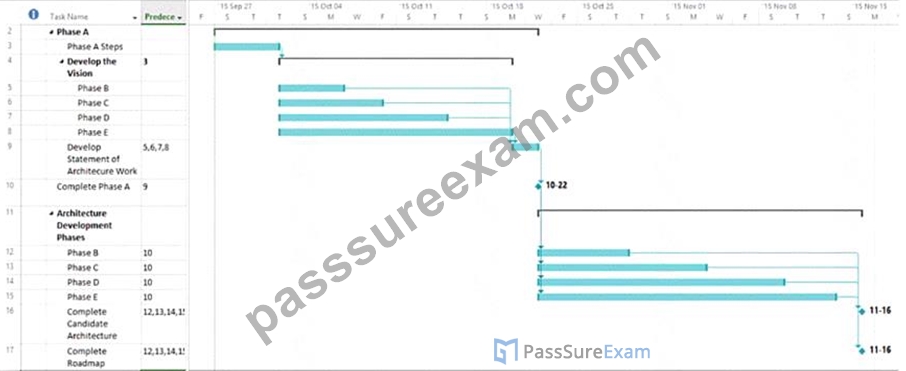
Which important concept for Enterprise Architecture Practitioners does it illustrate?
- A. An Enterprise Architecture must be developed in phases with a limited fixed duration.
- B. ADM phases must be run simultaneously until the relevant information has been produced.
- C. ADM phases must be run in a sequenced approach to produce the Architecture.
- D. Enterprise Architects must use Gantt charts to communicate with Stakeholders.
Answer: C
Explanation:
Explanation
The chart shown is a Gantt chart, which is commonly used for project management to illustrate a project schedule. In the context of TOGAF (The Open Group Architecture Framework), which is a framework for enterprise architecture, this Gantt chart is demonstrating the sequenced approach to the Architecture Development Method (ADM). The ADM is the core process of TOGAF which provides a tested and repeatable process for developing architectures. The ADM is described as being iterative, over the whole process, between phases, and within phases. For each iteration of the ADM, a fresh decision must be taken about each of the parameters (scope, granularity, time period, and architecture assets).
The ADM consists of a number of phases that have to be followed in sequence:
Preliminary Phase: Framework and principles
Phase A: Architecture Vision
Phase B: Business Architecture
Phase C: Information Systems Architectures, including Data and Application Architectures Phase D: Technology Architecture Phase E: Opportunities and Solutions Phase F: Migration Planning Phase G: Implementation Governance Phase H: Architecture Change Management Requirements Management Each phase is dependent on the outputs of the previous phase and the Requirements Management phase runs throughout. The Gantt chart clearly shows the dependency and sequence in which these phases occur, implying that a structured approach is followed to produce the enterprise architecture.
References:
The TOGAF Standard, Version 9.2, a standard of The Open Group
The TOGAF documentation available at https://publications.opengroup.org/standards/architecture and
https://publications.opengroup.org/guides/architecture
NEW QUESTION # 175
Complete the following sentence. In the ADM documents which are under development and have not undergone any formal review and approval process are_______________.
- A. Invalid
- B. Called ''draft''
- C. Known as ''Version 0.1''
- D. In between phases
Answer: B
Explanation:
In the ADM documents which are under development and have not undergone any formal review and approval process are called "draft". This indicates that they are subject to change and refinement as the architecture development progresses. Reference: The TOGAF Standard | The Open Group Website, Section
4.2.5 Architecture Deliverables.
NEW QUESTION # 176
Full Scenario
You are employed as an Enterprise Architect within the Enterprise Architecture (EA) team at a clinical research and health technologies company. The company has multiple divisions. Your team works within the healthcare division.
The healthcare division is always creating new products and needs to show the effectiveness and safety of the products. This happens in a set of clinical trials that satisfy the legal requirements of the relevant health authorities. The clinical trials are undertaken by the division's research laboratories at multiple facilities worldwide. At any time, there are many clinical trials happening. In addition to internal research and development activities, the healthcare division is also involved in publicly funded research projects with industrial and academic partners.
Your team is working on an architecture project to develop a secure system that will allow the healthcare researchers to share information more easily about their clinical trials. It will make working together easier across the organization. This system will also allow secured collaboration with external partners.
The EA team uses the TOGAF Architecture Development Method with adaptations required to support healthcare production methods and laboratory procedures. Due to the highly sensitive nature of the information that is managed, special care has been taken to ensure that each architecture domain considers the privacy and safety concerns.
The EA team has been instructed to minimize disruptions to the trials and to gradually introduce the new system.
The company has an established EA practice and has adopted the TOGAF standard for use in its architecture work. The EA practice is federated, which allows some interoperability and information sharing between the divisions yet permits partially independent activity. The Vice President of the healthcare division is the sponsor of the Enterprise Architecture activity for your EA team.
As part of introducing the new system, how would you go about breaking down the project into work packages?
Based on the TOGAF standard which of the following is the best answer?
- A. Use a Consolidated Gaps, Solutions, and Dependencies Matrix as a planning tool; classify solutions, group similar ones, and regroup into Capability Increments documented in an Architecture Definition Increments Table.
- B. Identify Solution Building Blocks needing development or procurement, eliminate duplicates, group with CRUD matrices, rank work packages, select cost-effective options, and schedule rollouts in Transition Architectures.
- C. Use Solution Building Blocks from a Consolidated Gaps, Solutions, and Dependencies Matrix and group into work packages, sequence them, and document rollout using a Transition Architecture State Evolution Table.
- D. Create an Implementation Factor Catalog to indicate actions and constraints. Draw up a matrix with architecture domains and gaps. For each gap, classify solutions as new development, purchased, or existing product. Group similar activities into work packages, identify dependencies, and regroup them into Capability Increments scheduled across Transition Architectures.
Answer: D
Explanation:
In TOGAF, the process of breaking down an initiative into work packages must be grounded in a structured evaluation of gaps, solutions, dependencies, constraints, and implementation factors. Option B precisely follows this guidance. It begins by producing an Implementation Factor Catalog, which is a TOGAF artifact used to record business, technical, regulatory, organizational, and risk considerations that influence implementation. This is especially relevant in the scenario because clinical trials operate under strict regulatory controls, highly sensitive data, and complex coordination across multiple research sites.
Next, Option B calls for creating a gap matrix comparing baseline and target architectures across domains. For each gap, TOGAF requires classification of solution approaches: new development, purchased solution, or reuse of existing components. This aligns directly with the Solutions Continuum and the practice of forming Solution Building Blocks. Grouping similar activities into work packages is also textbook ADM practice, ensuring traceability from architecture gaps into actionable implementation components.
Furthermore, Option B incorporates dependencies analysis and restructures work packages into Capability Increments, which is the TOGAF-recommended method for incremental delivery and Transition Architectures. This matches the scenario's requirement for gradual rollout to minimize disruption to ongoing clinical trials.
Thus, Option B fully reflects the TOGAF standard for structured work package definition.
NEW QUESTION # 177
......
OGEA-103 certification is an essential certification of the IT industry. Are you still vexed about passing OGEA-103 certification terst? PassSureExam will solve the problem for you. Our PassSureExam is a helpful website with a long history to provide OGEA-103 Exam Certification training information for IT certification candidates. Through years of efforts, the passing rate of PassSureExam's OGEA-103 certification exam has reached to 100%.
Valid OGEA-103 Test Forum: https://www.passsureexam.com/OGEA-103-pass4sure-exam-dumps.html
- New OGEA-103 Cram Materials ???? OGEA-103 Upgrade Dumps ???? OGEA-103 Real Brain Dumps ???? Download ▛ OGEA-103 ▟ for free by simply searching on ➽ www.validtorrent.com ???? ????OGEA-103 New Dumps
- Free PDF The Open Group - Professional OGEA-103 - TOGAF Enterprise Architecture Combined Part 1 and Part 2 Exam Detail Explanation ???? Open website ⮆ www.pdfvce.com ⮄ and search for { OGEA-103 } for free download ????OGEA-103 Exam copyright
- OGEA-103 new questions - OGEA-103 dumps VCE - OGEA-103 dump collection ???? Search for [ OGEA-103 ] on ☀ www.vce4dumps.com ️☀️ immediately to obtain a free download ????OGEA-103 New Dumps
- Test OGEA-103 Questions ???? Test OGEA-103 Questions ✔ Test OGEA-103 Collection ???? ➡ www.pdfvce.com ️⬅️ is best website to obtain ➠ OGEA-103 ???? for free download ????Free OGEA-103 Dumps
- OGEA-103 New Dumps ???? OGEA-103 Latest Test Online ???? OGEA-103 Exam copyright ???? Search for { OGEA-103 } and download exam materials for free through ➥ www.practicevce.com ???? ????Valid OGEA-103 Test Registration
- Exam OGEA-103 Training ???? Reliable OGEA-103 Test Price ???? OGEA-103 Real Brain Dumps ⚒ Open ➡ www.pdfvce.com ️⬅️ enter ➡ OGEA-103 ️⬅️ and obtain a free download ????Latest OGEA-103 Exam Cram
- 100% Pass Quiz Professional The Open Group - OGEA-103 - TOGAF Enterprise Architecture Combined Part 1 and Part 2 Exam Detail Explanation ???? Simply search for [ OGEA-103 ] for free download on { www.examdiscuss.com } ????Free OGEA-103 Dumps
- OGEA-103 Real Brain Dumps ???? Test OGEA-103 Collection ???? copyright OGEA-103 Torrent ???? ➽ www.pdfvce.com ???? is best website to obtain ➠ OGEA-103 ???? for free download ????OGEA-103 Upgrade Dumps
- High-quality OGEA-103 - TOGAF Enterprise Architecture Combined Part 1 and Part 2 Exam Detail Explanation ???? Search for ➠ OGEA-103 ???? on ▷ www.validtorrent.com ◁ immediately to obtain a free download ????OGEA-103 New Dumps
- High-quality OGEA-103 - TOGAF Enterprise Architecture Combined Part 1 and Part 2 Exam Detail Explanation ???? Search on 「 www.pdfvce.com 」 for ➤ OGEA-103 ⮘ to obtain exam materials for free download ????OGEA-103 Reliable copyright Ppt
- OGEA-103 Latest Exam ???? Test OGEA-103 Questions ⌛ OGEA-103 Latest Exam ???? Open ➥ www.verifieddumps.com ???? and search for 《 OGEA-103 》 to download exam materials for free ????Valid OGEA-103 Test Registration
- tessfpvc908484.wikiworldstock.com, larissazbkn629639.izrablog.com, bookmarkgenius.com, nettietbxc265614.blogcudinti.com, zaynabljvs276924.blogsvirals.com, haleemaskpo069116.blog5star.com, redhotbookmarks.com, haleemaesal353043.blogsvila.com, zakariacgda550857.dreamyblogs.com, haimalybz770641.blog-kids.com, Disposable vapes
P.S. Free 2026 The Open Group OGEA-103 dumps are available on Google Drive shared by PassSureExam: https://drive.google.com/open?id=1p8zPDwFnvdW_Xg4PDG56Sn-S9Px5qKui
Report this wiki page